
Bespoke kitchens, made in Essex
En Masse Bespoke designs and makes bespoke kitchens in Essex, each for one client and one space only. Here is one of them, and the words of four councils on kitchens in listed houses.
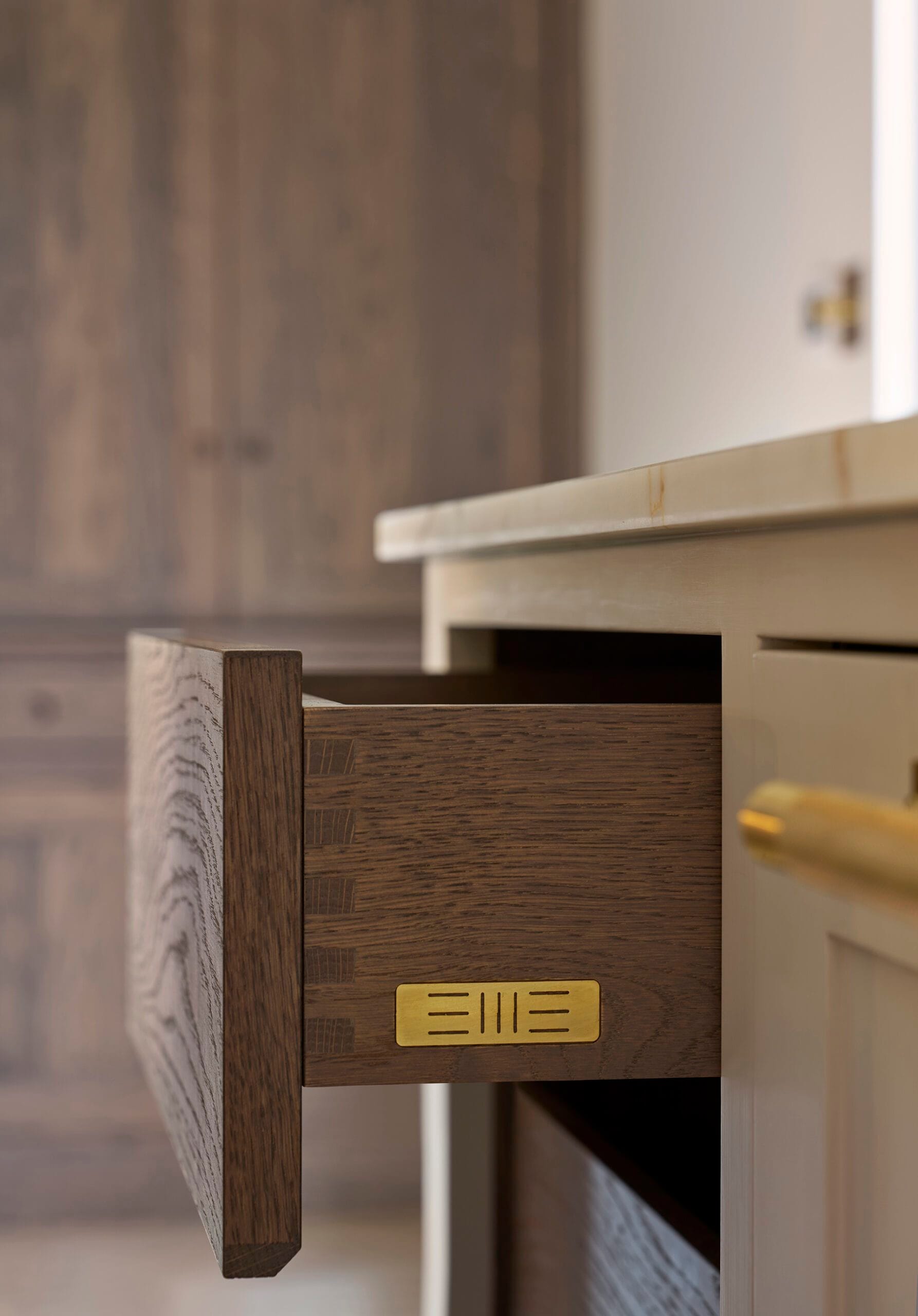
A Georgian house, and one drawer.
A dark oak drawer, open. At the corner, five blocks of end grain show where the boards meet. On the side is a small brass maker's plate, marked with nine short lines. Shut the drawer and both are gone.
It was made in Essex and it stands in Essex. The workshop is at Rayne. The design studio is at Great Notley, the next parish. The house is Georgian, and in the same county.
The plate carries no word, no town and no date. It is seen by whoever opens the drawer.
The range, the stone, the island.
The same room has a La Cornue Chateau 180. Behind it two slabs of Calacatta Borghini meet, bookmatched. What the vein does on the left it does again on the right, reversed.
The island is a bespoke brass frame under a marble top. The floor is oak, laid in herringbone. A wall of dark oak holds a bar that folds away.
This kitchen is here for what was made and for the county it stands in. It is not an example of consent, and nothing on this page says whether the house is listed.
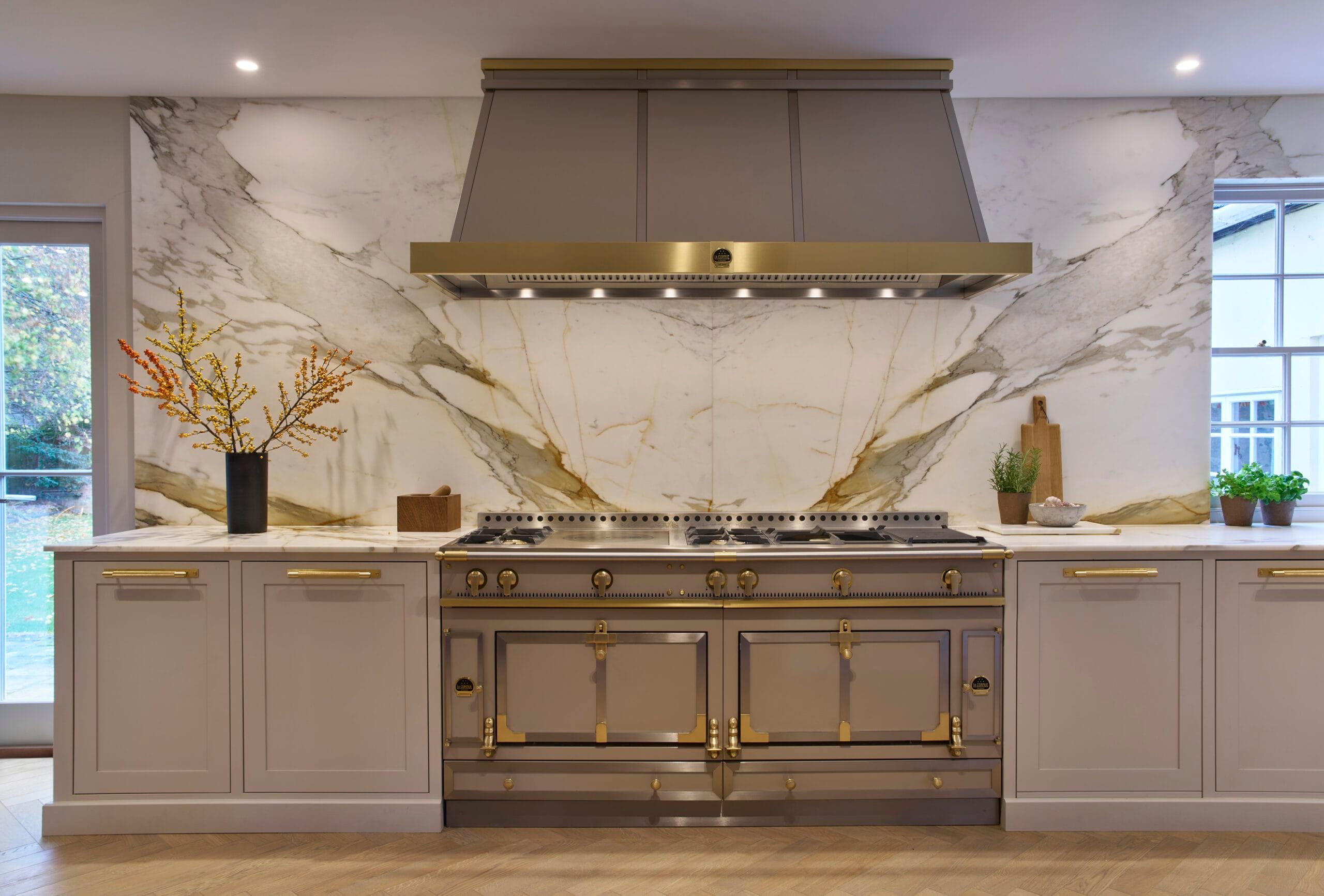
What a bespoke kitchen maker can make for an Essex house.
A farmhouse at Dedham, a brick front in Stock, a timber frame in Saffron Walden and a divided house in Leigh-on-Sea ask for four drawings. En Masse Bespoke is kitchen designer and maker in one, so the drawing and the bench are under one name.
In the old part of a house, a handmade kitchen may be an inframe kitchen. Each door hangs inside its own frame, and the frame can be scribed to a wall that leans. A classic kitchen takes its mouldings from the room. A period house kitchen may be either.
A later wing or a converted barn puts a different question. There a modern or contemporary kitchen can stand clear of the walls, with a kitchen island at the centre and stone worktops that touch nothing old.
The Georgian house above has its coffee station behind pale doors, where another house might have a pantry or a larder. Beyond the kitchen we make living spaces, libraries and wardrobes among them, and single pieces of furniture.
Kitchens in listed buildings, as four councils put it.
In a listed house the council may have a say in the kitchen. Essex has more than one council, and they do not use the same words. We read four of them on 23 November 2026: Chelmsford, Braintree, Epping Forest and Tendring. Their pages are linked here. We have not read the others for this page and do not speak for them.
Chelmsford and Braintree both tell you first that any work on a listed building needs consent. Then they give a short list of work that does not, and modern kitchen fittings are on it. That makes the kitchen an exception, and the word to notice in it is modern.
None of the four mentions a flue, an extractor or a kitchen drain. None mentions moving a kitchen to another room. Those have to be asked about. Work done without a consent it needed is a criminal offence.
Two councils count the additions.
Chelmsford and Braintree say the listing includes additions to the original building. So a kitchen in a later wing is not outside it because the wing is newer. The cupboards may be modern. The wall behind them may not be.
Beyond the house, the date is 1948. In general, Chelmsford and Braintree count a structure in the grounds as part of the listing if it serves the main building, dates from before 1948 and was in the curtilage when the house was listed. Entries added or amended from 2013 may expressly leave such buildings out. Epping Forest and Tendring use 1948 too. A kitchen planned for a barn starts with the same question as a kitchen planned for the house.
The line goes round what the kitchen touches.
Read together, the four pages do not draw a line round the kitchen. Two of them let the modern fittings go. What they hold on to is the house: a door, a fireplace, a run of plaster, a panelled wall, the opening between two rooms. Epping Forest calls it "a matter of judgement" which parts matter most. This is our reading, and not a ruling.
It is a line a joiner can work to. A cupboard has a back, two sides and a base, and each of them meets something. In a listed house the question is what that something is, and how old.
The plans and three-dimensional drawings are refined before any timber is cut. That is the time to mark what the kitchen would meet, and to put it to the council. An application to Braintree needs plans and documents that describe the work. Nothing has been made yet, so nothing has to be defended.
No drawing answers the question. The council does.
What each council says
- Chelmsford
- Listing covers "the exterior and interior" and any structure fixed to the building. Consent is definitely needed to "remove historic doors, fireplaces, plasterwork or panelling". It is not needed to "replace modern kitchen and bathroom fittings". The page does not say when a fitting counts as modern. Contact the council if you are unsure.
- Braintree
- The same two lines, word for word, and modern is not defined here either. Pre-application advice comes from a planning officer and a heritage officer. A Lawful Development Certificate "will give formal confirmation that your work does not need listed building consent".
- Epping Forest
- Any work that could affect the character of the building needs consent. Anything fixed to it is listed, "whether it is mentioned in the list description or not". Examples of work that needs consent include "Removal of interior doors" and "Creation of through rooms". The list is not complete, and says so. Kitchens are not mentioned. Check with its planning services before any work.
- Tendring
- Consent is needed for any work, inside or outside, that would affect special character or appearance "in any way". Kitchens are not mentioned. Pre-application advice gives confirmation in writing.
Bespoke kitchens in Essex, from studio to workshop.
David Conlon founded En Masse Bespoke in 2003. The studio at Great Notley is open by appointment only. The cabinetry is made in our workshop at Rayne.
We oversee every stage, from the first conversation to the final installation, and work alongside architects and interior designers. Where an architect is already at work on a listed house, both sets of drawings should agree before the council sees either.
Questions
Do I need listed building consent for a new kitchen in Essex?
It depends on the council and on what the work touches. Chelmsford and Braintree say replacing modern kitchen fittings does not need consent, and removing historic doors, fireplaces, plasterwork or panelling does. Epping Forest and Tendring do not mention kitchens. They ask whether the building's character would be affected. Ask yours in writing.
How do I get the answer in writing?
Braintree says to apply for a Lawful Development Certificate. Tendring recommends pre-application advice, which lets the council confirm in writing whether consent is required. Chelmsford says to contact it, and Epping Forest to check with its planning services. Neither page describes a written answer, so ask for one.
Can I take down the wall between the kitchen and the next room?
In Epping Forest, "Creation of through rooms" is on the council's list of work to a listed building that needs consent. Removing structural timbers is there too. The wording is Epping Forest's own. The other three pages do not use it. Ask your council before the two rooms are drawn as one.
Can I move the kitchen to another room in a listed house?
None of the four pages says. Two let modern fittings be replaced, and a kitchen in a new room is more than a replacement. It may need pipes, a way out for steam and fixings in walls that had none. Take the plan to the council before choosing the room.
How do I find out whether my house is listed?
Braintree and Tendring each have a map online that shows listed buildings. The National Heritage List for England covers the whole county. Tendring warns that house names change, so search under the old one too. Epping Forest adds that a list description is not meant to name everything protected.
Start with the house.
Tell us where it is, which room, and whether it is listed.
Start a commission